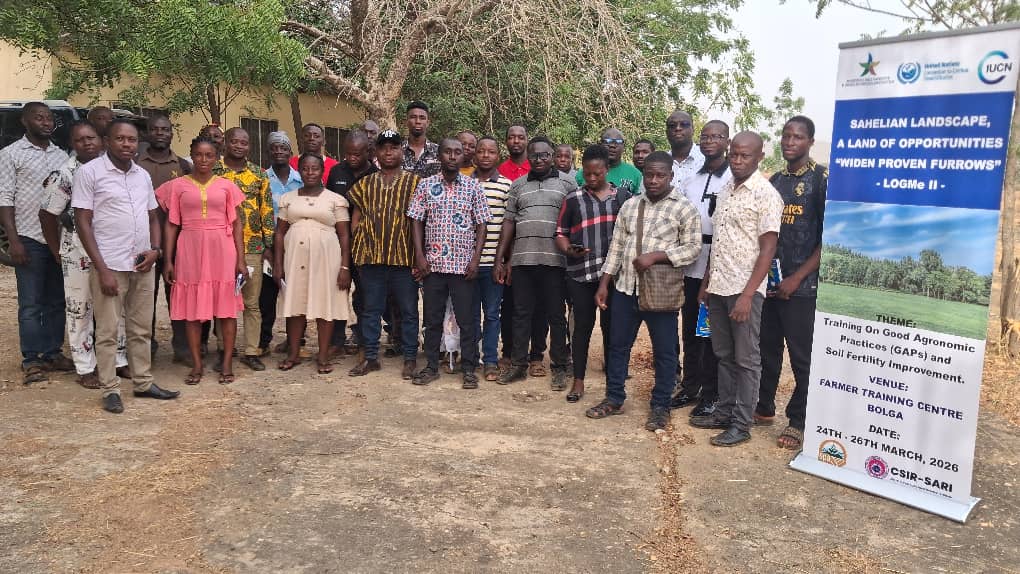
Pusu-Namongo (U/E), March 26, 2026 – The Savanna Agricultural Research Institute of the Council for Scientific and Industrial Research (CSIR-SARI) has trained lead smallholder farmers and extension officers on improved agronomic practices and soil fertility management.
The three-day workshop focused on key staple crops such as maize, soybean and cowpea, equipping participants with practical knowledge and improved farming technology in land preparation, timely planting, fertilizer application, crop protection and harvesting techniques among others.
Participants were also taken through biochar production, an innovative soil enhancement method that improves soil structure, retains moisture and boosts fertility and yields.
The move was part of intensified efforts to boost agricultural productivity in northern Ghana, build community resilience and improve food and nutrition security
The Training of Trainers was part of the implementation of the “Sahelian Landscape: Land of Opportunities-Widening Proven Furrows (LOGMe II)” project, brought together lead smallholder farmers from selected communities in the Talensi and Builsa South Districts.
The LOGMe II project which is building on the successes of LOGMe I is being implemented by the International Union for Conservation of Nature (IUCN) and benefiting five countries including Ghana, Burkina Faso, Niger, Binin and Senegal.
The three-year project, funded by the Italian Ministry of Environment and Energy Security through the United Nations Convention to Combat Desertification (UNCCD) Global Mechanism is part of broader regional intervention to combat land degradation and promote sustainable livelihoods across the five Sahelian countries harshly bit the impact of climate change.
In Ghana the project is being implemented in partnership with CSIR-SARI, Environmental Protection Authority and the Ministry of Food and Agriculture in 15 communities in four districts including Talensi and Builsa South in the Upper East Region and Sissala East and Jirapa Municipals in the Upper West Region.
Speaking on the sidelines of the training in Pusu-Namongo, Dr Iddrisu Yahaya, Principal Investigator of the project and Principal Research Scientist at CSIR-SARI, said the initiative was designed to address key challenges affecting smallholder farmers, including low yields, soil degradation, and climate variability.
He explained that the project, which began implementation earlier this year, followed a community needs assessment conducted with support from the IUCN.
“As part of the implementation, we engaged communities to understand their specific needs, and based on that, we are providing training on good agronomic practices, soil fertility improvement and crop protection,” he said.
Dr Yahaya noted that the training formed part of a broader strategy to restore about 30,000 hectares of degraded land across the two regions, using climate-smart and nature-based solutions.
Dr Julius Yirzagla, a Principal Research Scientist and Agronomist at CSIR-SARI, said the training aimed to bridge the gap between research and practice by improving the adoption of existing agricultural technologies.
“Most farmers lack the requisite knowledge on good agronomic practices, which contributes to low yields. This training is meant to build their capacity and enable them to adopt improved technologies to enhance productivity and food security,” he said.
He emphasised that the training adopted a “training of trainers” approach, where selected lead farmers and extension officers would cascade the knowledge to other farmers within their communities.
According to him, practices such as the use of certified seeds, proper land selection, row planting, timely weeding, and appropriate fertilizer application were critical to increasing yields and building resilience against climate change.
Dr Yirzagla added that climate variability continued to pose a serious threat to agriculture, making it necessary for farmers to adopt adaptive strategies such as conservation agriculture and integrated soil fertility management.
Dr Peter Quandahor, Research Scientist and Entomologist, encouraged the farmers to adopt organic and agroecological pest control methods, including the use of neem-based extracts, crop rotation and intercropping, instead of relying heavily on synthetic pesticides.
“Using plant-based pest control methods is safer for human health, reduces production costs and protects the environment, while also preventing pest resistance,” he explained.
The beneficiary farmers lauded the training and said it had exposed them to practical techniques such as proper fertilizer application, timely harvesting and the use of biochar to improve soil fertility.
They expressed optimism that applying the knowledge gained would improve yields and increase their income levels.
Source: GNA