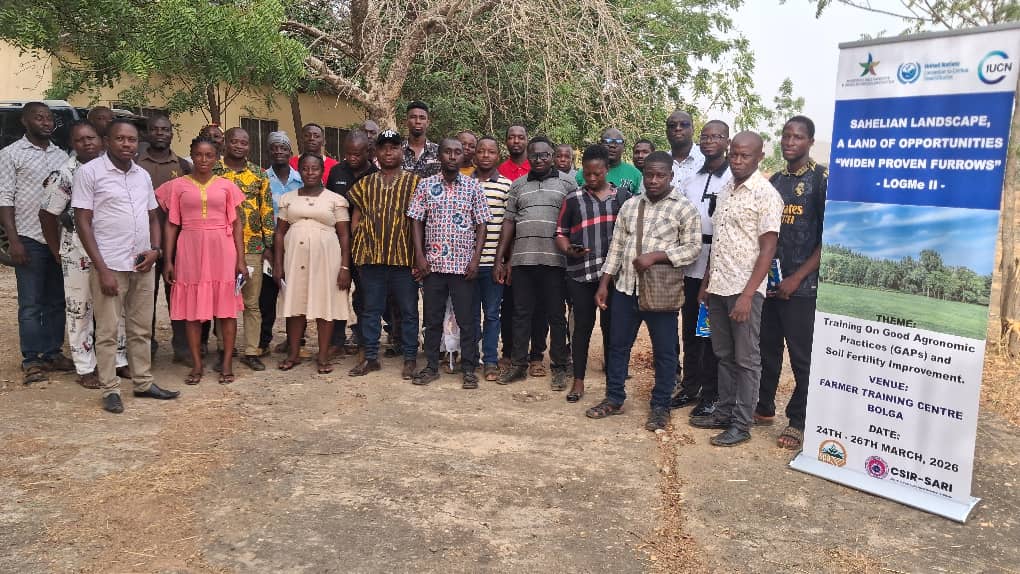
Pusu-Namongo (U/E), March 28, 2026 – The Savanna Agricultural Research Institute of the Council for Scientific and Industrial Research (CSIR-SARI) has intensified efforts to promote entrepreneurship among smallholder farmers in the Upper East Region.
The initiative, which aims at transforming subsistence agriculture into profitable business ventures, is part of the implementation of the “Sahelian Landscape: Landscape of Opportunities: Widening Proven Furrows (LOGMe II)” project.
The LOGMe II project, which is building on the successes of LOGMe I, is being implemented by the International Union for Conservation of Nature (IUCN) and benefits five countries, including Ghana, Burkina Faso, Niger, Benin, and Senegal.
The three-year project, funded by the Italian Ministry of Environment and Energy Security through the United Nations Convention to Combat Desertification (UNCCD) Global Mechanism, is part of a broader regional intervention to combat land degradation and promote sustainable livelihoods across the five Sahelian countries, which are harshly hit by the impacts of climate change.
In Ghana, the project is being implemented in partnership with CSIR-SARI, the Environmental Protection Agency, and the Ministry of Food and Agriculture in 15 communities in four districts, including Talensi and Builsa South in the Upper East Region, and Sissala East and Jirapa Municipals in the Upper West Region.
The LOGMe II project seeks to improve livelihoods by combining environmental restoration with entrepreneurship, positioning farmers to become competitive players in the agricultural value chain.
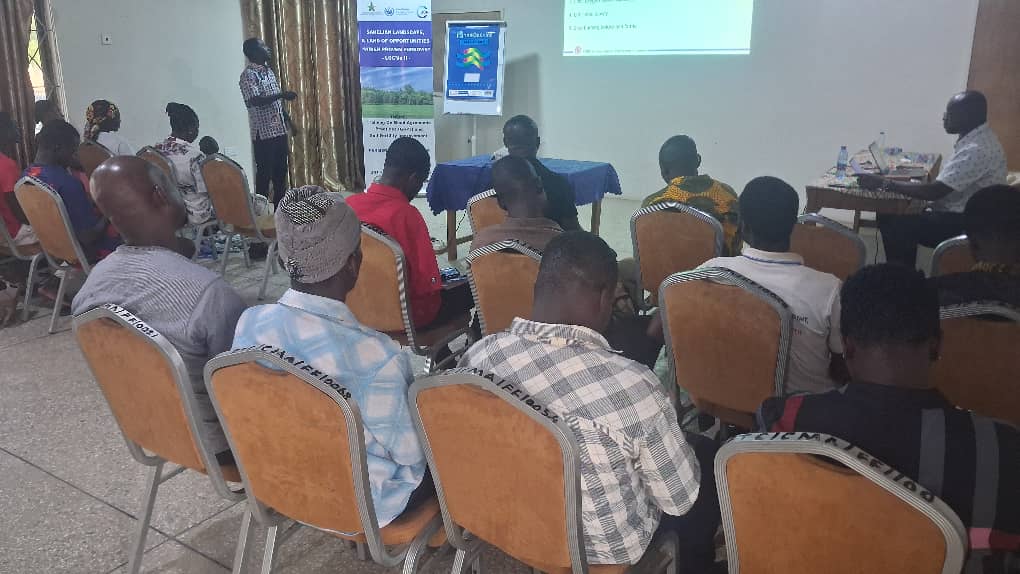
Speaking the training workshop in Pusu-Namongo in the Talensi District, Dr Iddrisu Yahaya, Principal Investigator of the LOGMe II project and Principal Research Scientist at CSIR-SARI, said the initiative was designed to equip farmers with practical business skills to enable them to add value to their produce, improve productivity, and access markets more competitively.
He explained that the project, which focuses on land restoration, integrates economic empowerment strategies to ensure that communities benefit financially while restoring degraded lands.
“We want farmers to take farming as a business and, beyond production, they must think about value addition, marketing, and profitability,” Dr Yahaya said.
According to him, the project has adopted a Training of Trainers (ToT) approach, where selected participants will cascade knowledge to between 50 and 100 people each within their communities.
“This approach will help us reach close to 3,000 beneficiaries by the end of the training,” he added.
Dr Yahaya noted that the training modules were informed by a recent community assessment involving 545 beneficiaries, 67 per cent of whom were women, who expressed interest in improving soil productivity, marketing their produce, and exploring additional income-generating opportunities.
As part of the training, participants were taken through entrepreneurship, Village Savings and Loans Associations (VSLA), and group formation to strengthen their bargaining power and access to financial support.
Dr Bashiru Haruna, a Research Scientist, emphasised the need for farmers to transition from subsistence farming to business-oriented agriculture through proper planning and record-keeping.
“We trained them on how to develop business plans and keep accurate production and financial records. This is critical for tracking progress and determining whether they are making a profit or loss,” he said.
He encouraged farmers to identify opportunities within and beyond agriculture, noting that innovation and creativity are key to improving livelihoods.
Dr Abdul Jelil Abukari, a Lecturer at Tamale Technical University and a marketing expert, highlighted the importance of customer relations and market access in agribusiness.
“There is no business without customers. Farmers must learn to build lasting relationships with their customers and ensure satisfaction so that they can benefit from word-of-mouth marketing,” he said.
He urged farmers to form cooperatives to strengthen their negotiating power and improve access to financial support from institutions and development partners.
Dr Abukari further encouraged participants to leverage digital platforms such as WhatsApp, Facebook, and TikTok to promote their products and engage with customers.
“Digitisation has come to stay; even small-scale farmers can use smartphones to market their products and interact directly with customers,” he noted.
Source: GNA