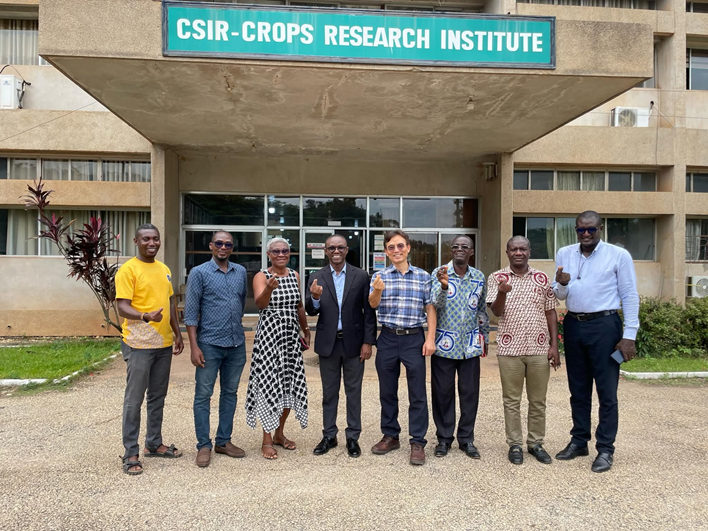
Kumasi, Jan. 22, 2026 – A project to address challenges and manage difficulty in controlling weeds in rice fields in the Dawhenya Irrigation Enclave (K Rice Belt) has been initiated.
The project, scheduled to run from 2025 to December 2027, is a collaboration between the Korea Program on International Agriculture (KOPIA), a South Korean initiative, being spearheaded by the Rural Development Administration (RDA) and the Crops Research Institute of the Council for Scientific and Industrial Research (CSIR-CRI).
Dr. Stephen Arthur and Dr. Grace Bolfrey-Arku, both Weed Scientists at CSIR-CRI, are the Project’s Principal Investigators.
The initiative aims to integrate a five (5) pronged approach – farmer interviews, systematic field monitoring, participatory field verification trials, farmer-focused feedback, and skills training to develop an integrated weed management strategy adapted to local conditions.
With this, the KOPIA RDA – CSIR-CRI Integrated Weed Management Project team is optimistic that, the evidence-based, farmer-centered weed management strategies participatory developed, and hinged on the five pillars, would ensure cost-effective weed control strategies that increase rice yields, reduce production losses, and build farmer capacity verified and developed.
Dr Arthur told the Ghana News Agency in an interview that, the initiative aimed to increase productivity by 5 percent in the enclave to strengthen national rice production and move Ghana closer to the goal of self-sufficiency in rice.
The project is also expected to reduce weed control costs incurred by farmers during production by 15 percent.
The farmer confidence would be enabled for peer knowledge sharing among farmers within the enclave through the consistent weed management training schedules and also enhanced capacity of the trained farmers to sustainably manage weeds, would promote the adaptation and adoption of the improved technologies beyond the Dawhenya Irrigation Enclave.
Additionally, opportunities for the diffusion and scale-out of improved weed management interventions beyond the enclave for adaptation and adoption through the enhanced knowledge and skills acquired by the farmers.
Source: GNA